


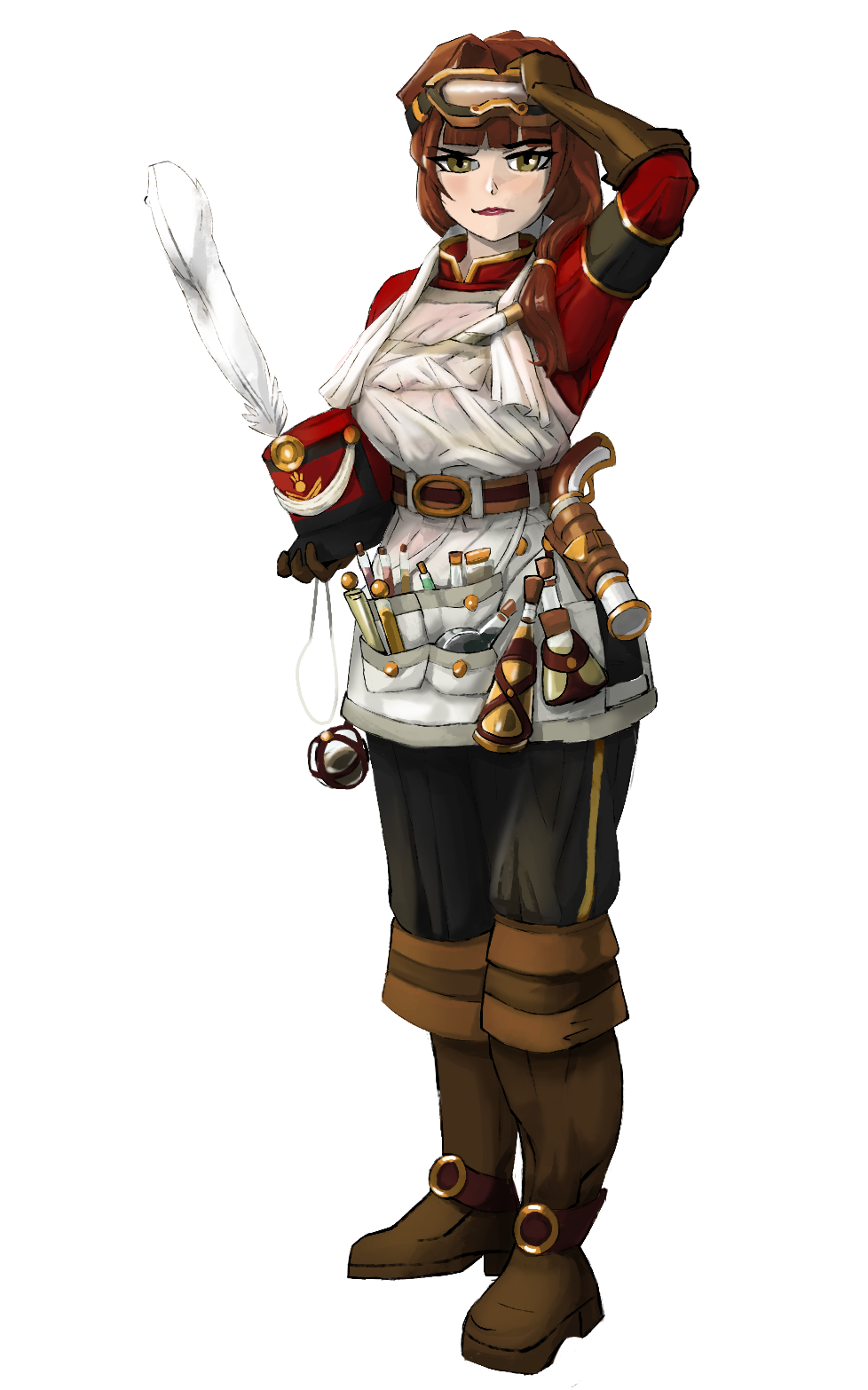
Meteor City was the biggest of boomtowns: an ugly, sprawling expanse, built in haste on the prairie wastes. The place was littered with skyships, docking towers, lodging houses, and most especially bordellos, built in every color of timber and bracketed in brightly painted signs.
Mara Bloom reckoned that there were forests with less wood than Meteor City.
But lumber shipments were hard to get across the mountains these days. For those cases there were tents. Big ones. The striped affair sitting on the end of this dusty street was near as big as the Lanva Royale, and it still had a line coming out of it that stretched all the way around the block, ending in front of a building covered in scandalously shapely masculine silhouettes.
The large woman made a note to visit when she was done. Assuming she got the recruitment bounty, anyway. She still wasn’t sure that she’d talk her way through that; she wasn’t even sure she’d talk herself into staying long enough to try. The line was long, noisy, and dense enough to be humid despite the dry galeren sun, and she didn’t have any interest in being a rebel for its own sake.
Beneath the hot sun, the wind howled and swirled across a vast and unending prairie; each gust seized hold of flaxen stalks and pulled, threatening to yank them out by their roots. But no matter how severe the gale, the wheat and rye survived, wafting back to vaguely upright positions.
Ffion Byrewythe could only hope she would be so lucky.
To her chagrin, the black robes the young woman wore had faded quickly in the few years since her last growth spurt, hardly any darker than her skin now. Made of durable canvas cloth, they still served her well, shielding Ffion against most of the stinging debris that came with the buffeting plainswind: dirt, detritus, and more than a few unfortunate vermin.
But sails were also made of canvas.
For the last hour Ffion’s blood had churned with magic – small little gestures, each individually too miniscule to be called a spell – bending that violent wind around her in subtle ways. Not enough to stop it, but enough to keep on her feet. She’d wear herself out if she tried anything more, as far as she had to go.
Flying made Knickers itchy.
He didn’t mean the undergarment, of course. Whether or not those were itchy was mostly a question of what they were made of, how well they were tailored and cared for. Knickers meant himself: the uniformed half-pint dandy rocketing above the clouds at a hundred and twenty miles per hour on feathered metal wings wider than he was tall.
Knickers – more properly Flight-Lieutenant Nicodemus Justinian Rose, Esquire, although he had been Knickers long before he’d chosen such a lovely polysyllabic name, gotten credentialed, or obtained an officer’s rank – was a rebel aerinyes. That meant that he both flew, and was, a death trap.
Toes wiggled inside of his boots, flicking at pneumatic switches as he kept his legs locked against the wind. There were a lot of dangers to flying this way – birds, weather, and you had to mind the rocket exhaust or it’d burn your feet. But he wouldn’t have survived this long if they bothered him. No, most of that was exciting, especially what the boots did for his thighs. There was no upside to the wind whipping at his flesh until everything was cold, numb and kind of itchy.
A soft and silent white blanketed the buildings and roads of Kipenzenia, uniting the old Verwaltung’s Palace and the new Jugendstil apartments alike under an intimate serenity. On an ordinary day, this would have been beautiful enough. Knickers found every day in the city fascinating. Once a nexus of the Red Death, Kipenzenia had already returned to being the heart of imperial aesthetics.
Today epitomized that. Snowflakes sparkled through a bright blue sky; as the diamond dust danced bashfully away from clouds unseen, they passed beneath the sun’s gaze and blushed rainbows in the passing.
It was the second most beautiful thing that Cadet Nicodemus Rose had ever gotten to appreciate in his life; he also appreciated that he got to appreciate it from the inside of a large picture window.
The reality of snow was a touch messier than the appearance of it.
His preference for skin-baring outfits was meteorologically unideal in local clime.
Also not ideal to do fine stitching with cold fingers.
The below articles are translated from Volkenvencht, originally appearing in the Persh 1, 1831 edition of Die Seherin – about three years into the twenty-two-year reign of the Red Death. Regrettably, tables, charts and other figures have not been reproduced due to extensive damage in extant archival copies.
GENTLE READER,
As we contemplate a fourth year of the Red Death, its spread throughout the Vencht Mountains continues unimpeded by the Imperial Hexenbauern. Although it has yet to reach as far west as Schongen Hill, many prominent wythes have withdrawn from the city in expectation of the worst. The widely-anticipated want of labor may prove of equal concern to reduced demand or capital in the course of years. Securities for rolling stock enterprises, even those most parochial and of little note in the Imperial City, have sharply depreciated in value and are expected to continue to do so.